Sporting Glory
West Indies Cricket, Bollywood Movies and UWI Come Together
1960-1961 Cricket Tour to Australia and First Tied Test Match
The West Indies cricket team toured Australia in 1960-61. For the first time in the history of West Indies cricket, the West Indies team was captained by a coloured man: Frank Worrell. For years, he had fought for equal recognition and pay for coloured players. His leadership during this tour was significant, as it marked a new era in West Indies cricket. The captain of the Australian team was Richie Benaud. The first Test played at Brisbane from December 9-14, 1960 was one of the most exciting of the series. It ended in a dramatic tie, the first ever in a Test match. This has happened only twice in the history of Test cricket.
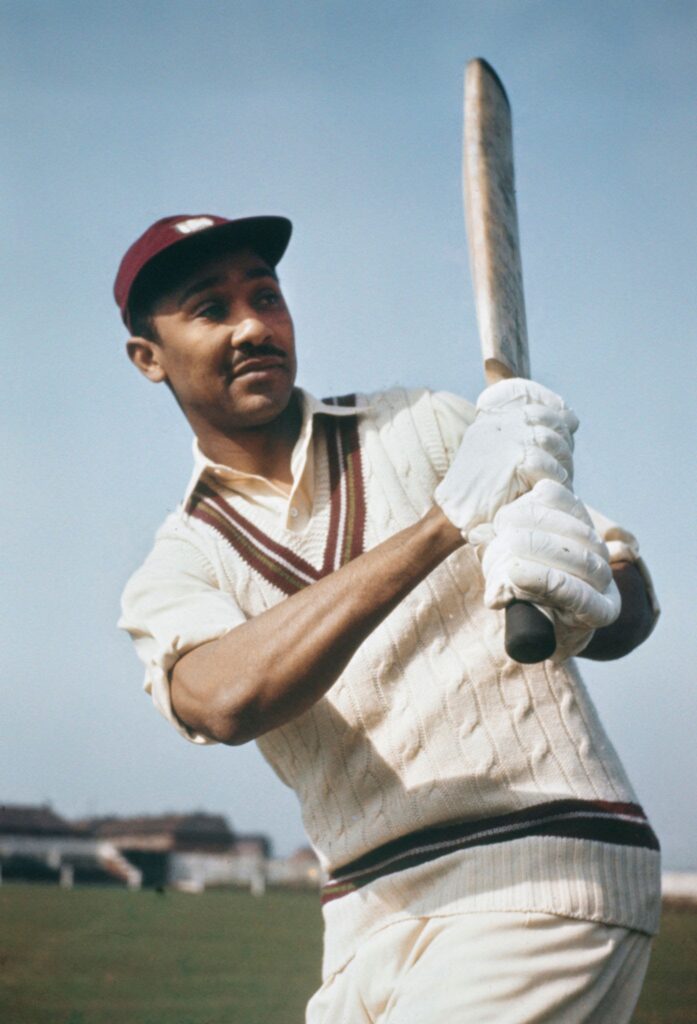
Sir Frank Worrell [1]
Last Over of the First Tied Test
At the start of the final over, Australia was 227 for seven. Australia needed 233 to win the match and lead the series. Wes Hall bowled the last over for the West Indies. In those days, an over in Australia comprised eight balls and not six. Here is a ball-by-ball account of what happened in that memorable final over.
- Ball #1
- Ball #2
- Ball #3
- Ball #4
- Ball #5
- Ball #6
- Ball #7
A single is taken by Wally Grout. The score is now 228 for seven and Australia needs 5 runs to win off 7 balls with three wickets in hand.
Wes Hall bowls a bouncer to Richie Benaud (disobeying instructions from his captain) who attempts a hook shot, gets a top-edge, and is caught behind by the wicketkeeper. The score is now 228 for 8 with two wickets remaining.
Dot ball (no runs) to the new batsman, Ian Meckiff.
Meckiff misses the ball but non-striker Grout calls for a cheeky bye. Meckiff is almost run out but it ends well and the score is now 229 for 8. Australia needs four runs from 4 balls to win.
Grout benefits from a dropped catch from Hall and takes a single. The score is now 230 for 8. Australia needs three runs to win from 3 balls.
Meckiff hits 2 and attempts to run a third to win. However, Grout is run out after an excellent throw to the wicketkeeper from Conrad Hunte. The score is now level. Australia needs 1 run to win off 2 balls with one wicket in hand.
The new batsman Lindsay Kline attempts to get a single to win the match for Australia but Meckiff is run out by a direct throw from Joe Solomon. Australia is 232 all out and the match is tied with one ball remaining.
The Last Over of the First Ever Tied Test Match
Remaining Test Matches
Australia won the second Test at Melbourne but the West Indies won the third Test at Sydney so the series was now tied. The fourth Test at Adelaide ended in a draw. The final Test held at Melbourne was a thrilling game like the first Test at Brisbane but it ended in a win for Australia. So, Australia won the Test series 2-1.
The West Indies team became extremely popular with the Australian public. To show their appreciation of Frank Worrell’s inspirational leadership, the Australian Cricket Board of Control presented the West Indies with a trophy called the Frank Worrell Trophy. Australia and the West Indies would compete for this trophy in subsequent years.
As of 2024, the West Indies and Australia competed for the trophy in 25 Test series. Australia won 15 of the series, the West Indies won 8, and three ended in draws. (The trophy is kept by the team holding it when there is a draw.)
Prior to their departure from Australia, the West Indies team were paraded through Melbourne in open-top cars on February 17, 1961 and were cheered by enormous crowds. Of Frank Worrell, they sang lustily, “For he’s a jolly good fellow!” and they called out to him and his men, “Well done, boys!” and “Come soon again!”
Political Change and the Birth of the University of the West Indies
In 1958, ten British Caribbean territories came together to form a political union called the West Indies Federation. It was intended to be a single, independent state within the British Commonwealth. Its capital was in Port of Spain, Trinidad and Tobago. Due to internal conflicts, the West Indies Federation collapsed and was eventually dissolved in 1962.
Soon, the winds of change started blowing across the Caribbean as the British territories sought to gain independence from Britain. Jamaica was the first to get independence on August 6, 1992. A few weeks later, on August 31, Trinidad and Tobago got independence. Barbados got independence on November 30, 1966.
On April 2, 1962, a Royal Charter was granted by Queen Elizabeth II, establishing the University of the West Indies (UWI) as an independent entity. And so it was that the UWI came into existence, with one campus in Mona, Jamaica and the other in St. Augustine, Trinidad and Tobago. A few years later, a third campus would be established in Barbados.
The St. Augustine campus of the University of the West Indies was formerly a sugar estate established in the 1800s. In 1921, the estate was handed over to the West Indies Agricultural College when it was established on August 30. It was renamed the Imperial College of Tropical Agriculture (ICTA) in 1924. In 1960, ICTA became known as the University College of the West Indies (UCWI), St. Augustine campus. The first campus of the UCWI had been established in Mona, Jamaica in 1948 and was affiliated with the University of London. In 1962, the UCWI received independent university status through the Royal Charter.
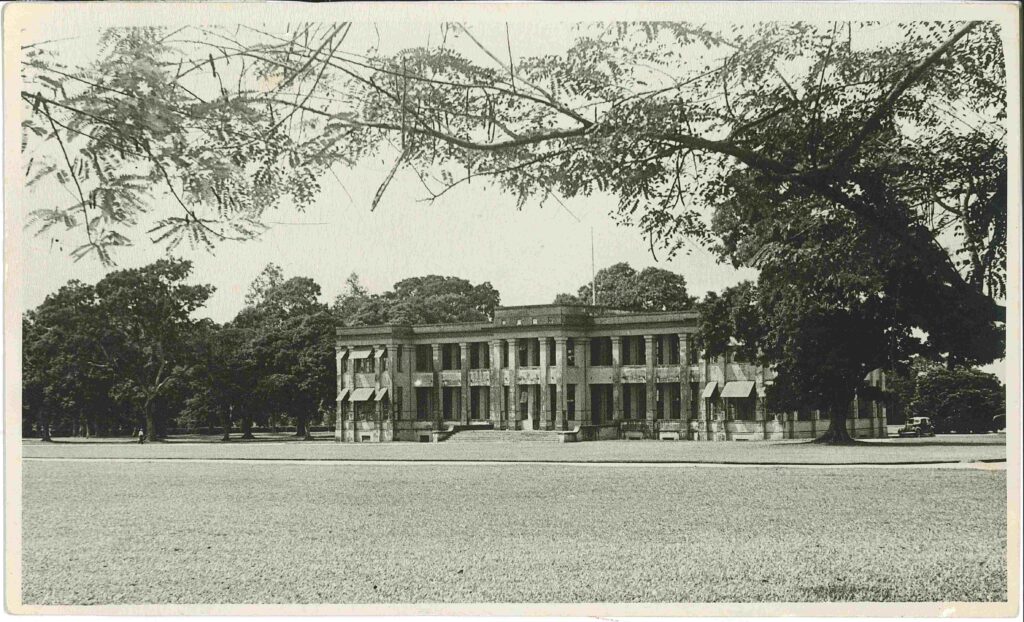
Old Administrative Building at the University of the West Indies
(formerly known as “The Imperial College” and “The University College of the West Indies”) [2]
The growth and development of the UWI became closely tied to the progress of the former British territories as they gained independence. UWI’s expansion and its role in education and research have significantly contributed to the development of the English-speaking Caribbean countries.
Frank Worrell Retires
After the triumphant tour of Australia, Frank Worrell was made Warden of Irvine Hall at the University College of the West Indies in Jamaica. Later on, he became a Senator in the Jamaica House of Representatives when Sir Alexander Bustamante became Prime Minister in 1962. He retired from Test cricket in August 1963.
On New Year’s Day 1964, Frank Worrell received the wonderful news that he was to be knighted by Queen Elizabeth II. From that day forward, he would be known as Sir Frank Worrell, a title that recognized his significant contributions to cricket and his leadership as the first coloured captain of the West Indies cricket team.
In October 1964, Sir Frank Worrell was seconded to the Government of Trinidad and Tobago as a Community Development Adviser. When Prime Minister Dr. Eric Williams opened the first National Youth leadership course on Nelson Island, Sir Frank Worrell addressed the 50 youth leaders who attended. He stressed the value of cooperation and the contribution which the young people of Trinidad and Tobago could make to their nation, which had only recently gained its independence.
He was assisted for a period by Garry Sobers and Rohan Kanhai, two prominent West Indian cricketers. Sir Frank Worrell through his association with the community centres and secondary schools helped to develop cricketing talent in Trinidad and Tobago. At the end of his year of secondment, Sir Frank Worrell did not return to Jamaica. He was made Dean of Students and Director of Sports at the St. Augustine campus of the newly established University of the West Indies.
He took the greatest interest in seeing that students had plenty of facilities for recreation. Behind Canada Hall, a residential block which had been a gift from the Government of Canada, stretch the university playing fields. In honour of his contributions, the fields were renamed the Sir Frank Worrell Playing Fields. Today, they are known as the Sir Frank Worrell Memorial Ground.
Late in 1966, the Indian High Commissioner to Trinidad and Tobago, Mr. Muni Lall invited Sir Frank Worrell to make a tour of Indian universities. Mr. Lal was impressed at how Sir Frank Worrell had moulded the players from the various Caribbean islands into one united whole. Perhaps, he would be able to bridge the gap between India and Trinidad and Tobago, by helping them to understand more about each other, and so establish closer ties between the two countries.
Towards the end of December 1966, Sir Frank Worrell left Trinidad for India. The tour lasted six weeks. At Panjab University in Chandigarh, the Honorary Degree of Doctor of Literature was conferred upon Sir Frank Worrell. This was India’s way of paying tribute to one who had broken known the barriers of race and class.
Sir Frank Worrell’s trip to India coincided with the last part of the tour of the West Indies cricket team to India in December 1966 and January 1967. The West Indies won the 3-match Test series 2-0. It is possible that Sir Frank Worrell met the West Indies team in January 1967 while on his own tour to Indian universities.
Shortly after the graduating ceremony at Panjab University, Sir Frank left India. He was having health issues even before he left Trinidad for India. The health issues had worsened in India. So, he decided to stop over in Jamaica and visit the doctors at the University of the West Indies before proceeding to Trinidad where he lived. Unfortunately, Sir Frank Worrell passed away in Jamaica on March 13, 1967 due to cancer at the age of 42. His body was eventually flown to his home country, Barbados for burial at what would later become the Cave Hill campus of the University of the West Indies.
In England, a special memorial service was held in his honour at Westminster Abbey in April 1967. He was the first sportsperson to be honoured with a service in the 900-year-old Westminster Abbey. The Archdeacon of Westminster, Dr. Edward Carpenter, referred to Sir Frank Worrell as “a distinguished citizen of Barbados,” and spoke about Worrell’s hopes that “through sport, barriers might be broken down and men of all nations brought together into the bonds of fellowship.”
Around the World
The Bollywood movie, “Around the World” was filmed in Trinidad and Tobago and several other countries such as the United States, Canada, Switzerland, French Polynesia, and Japan. The film is a romantic comedy directed by Pachhi. It stars Raj Kapoor who travels around the world with eight dollars, during which he learns some valuable lessons in life and finds love. Also starring in the movie are Rajshree, Mehmood, and Om Prakash. It was India’s first film to be released in 70 mm format.
“Around the World” was a box office failure. In 1977, Raj Kapoor mentioned that he disliked the film and he was also critical of Pachhi’s direction. He confessed that he acted in the film for money, “Like Orson Welles, I had to act in bad films to make good ones myself”. Still, its theme was consistent with the ideals of Sir Frank Worrell: “Let’s go around the world, let’s see the world, and as you meet people, befriend them, and share your love with them.”
In one of the scenes from the movie, Om Prakash and Mehmood meet two boys playing cricket on the field to the west of the old Administration Building of the St. Augustine Campus of the UWI.
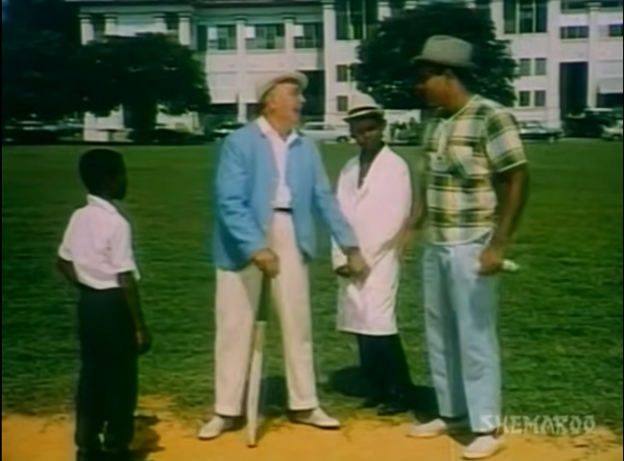
Om Prakash, Mehmood, and Two Boys in Front of the Administration Building at UWI, St. Augustine (1966)
Om Prakash and Mehmood in Front the Administration Building at UWI, St. Augustine (1966)
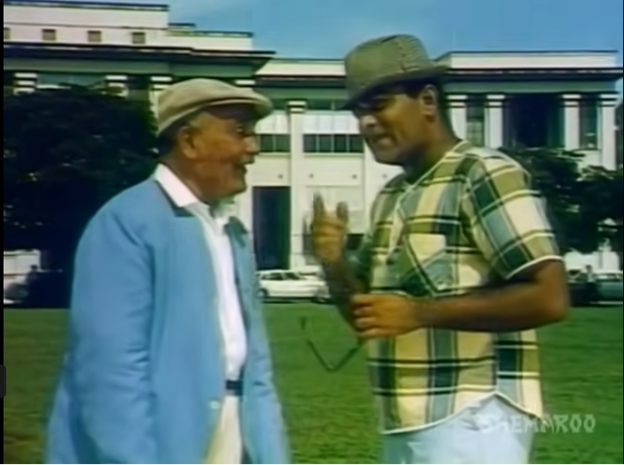
Later in the scene, Sir Frank Worrell makes a cameo appearance, dressed in flannels. After meeting Om Prakash and Mehmood, there is a short dialogue between Om Prakash and Sir Frank Worrell. Om Prakash asks Sir Frank Worrell some senseless questions: whether he knows Milkha Singh (a famous Indian athlete at the time), “India’s greatest fast bowler”; Shammi Kapoor (a popular Bollywood star), “India’s greatest wicket-keeper” and Mohammad Rafi (a famous Bollywood playback singer), “India’s opening batsman who’s always not out”. Sir Frank Worrell handles his silly questions with poise and walks away. The scene can be viewed in the video below:
Around the World – Sir Frank Worrell meets Om Prakash and Mehmood
The scene was most likely filmed in 1966 when Sir Frank Worrell was Dean of Students and Director of Sports at the St. Augustine campus.
The movie also features a song scene with Om Prakash and Mehmood and two local beauties (identified in the credits as Ms. Shelly and Ms. Katharine) filmed at the Trinidad Hilton Hotel in St. Ann’s, Port-of-Spain. Like the St. Augustine Campus of the University of the West Indies, the Trinidad Hilton Hotel had opened its doors in 1962, being the fourth international location for the Hilton chain of hotels.
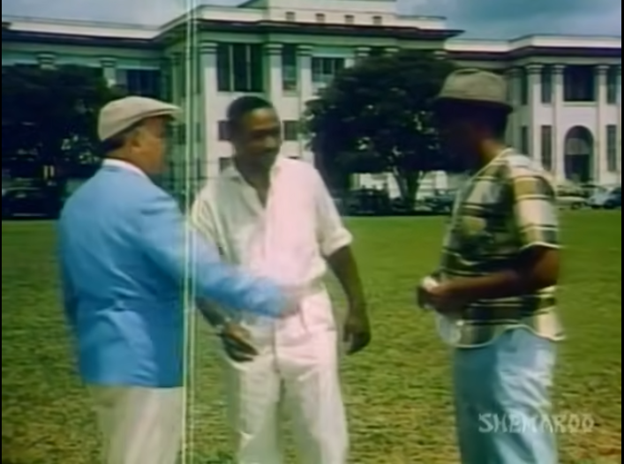
Om Prakash and Mehmood meet Sir Frank Worrell (Around the World 1967)
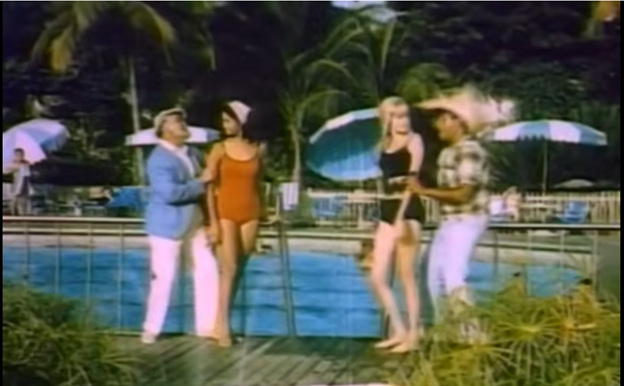
Om Prakash and Mehmood in a Scene from the Movie at the Hilton Hotel, Port-of-Spain (1966)
The movie was released in India in 1967. By the time it was released, Sir Frank Worrell had already died. The movie starts with a dedication to Sir Frank Worrell:
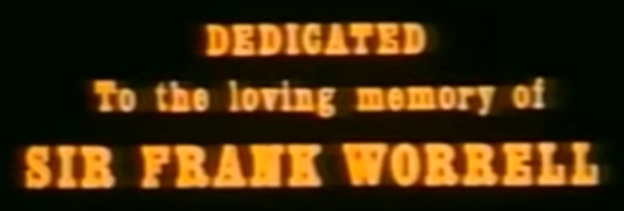
Typically, Indian movies are shown in Trinidad 1-2 years after being released in India. However, because of the death of Sir Frank Worrell, the movie was released much earlier in Trinidad on November 9, 1967, the same year of its release in India.
Books About Frank Worrell (referenced)
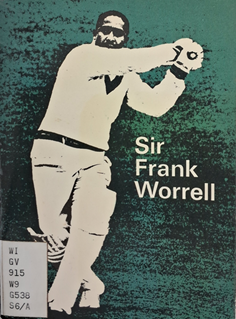
Giuseppi, Undine (1969). Sir Frank Worrell. Trinidad: Thomas Nelson and Sons Ltd. (Men of Greatness Series)
This book provides a short biographical look at Sir Frank Worrell’s life and career. The book is designed for children, but it is sure to delight people of all ages.
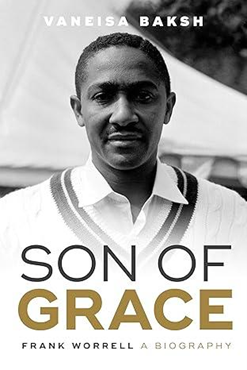
Baksh, Vaneisha (2024). Son of Grace: Frank Worrell – A Biography. UK: Fairfield Book Publishers.
The book provides a detailed account of Sir Frank Worrell’s life and career. Although it describes Sir Frank’s exploits as a cricketer and captain of the West Indies team, the biography is more about the man, Sir Frank Worrell. It is particularly strong on his early days in Barbados. The book is a must-read for cricket fans everywhere
References
[1] Barbados Today (2024). ‘Saluting Sir Frank Worrell – The Icon and Statesman Who Changed the World of Cricket’. Available from:
[2] UWI, St. Augustine, Campus News (2023). ‘UWI Marks 63rd Founders Day: Rooted in History, Ready for Today, Rising for Tomorrow’, Uwi.edu. Available from:
In Memory of Sir Frank Worrell
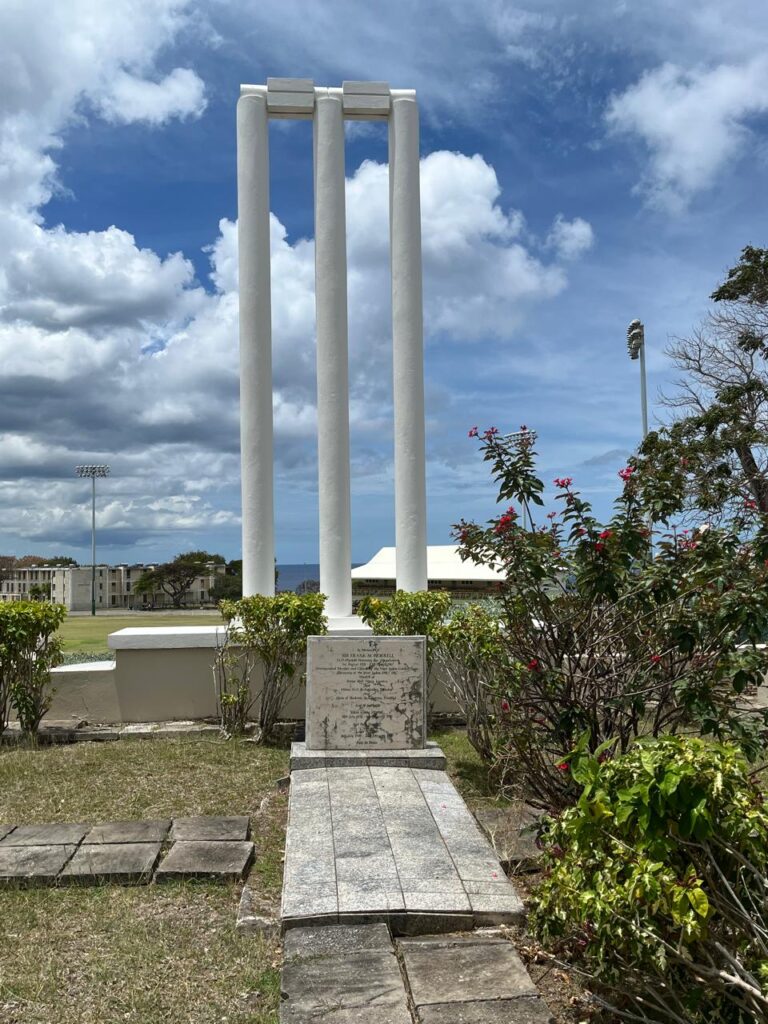
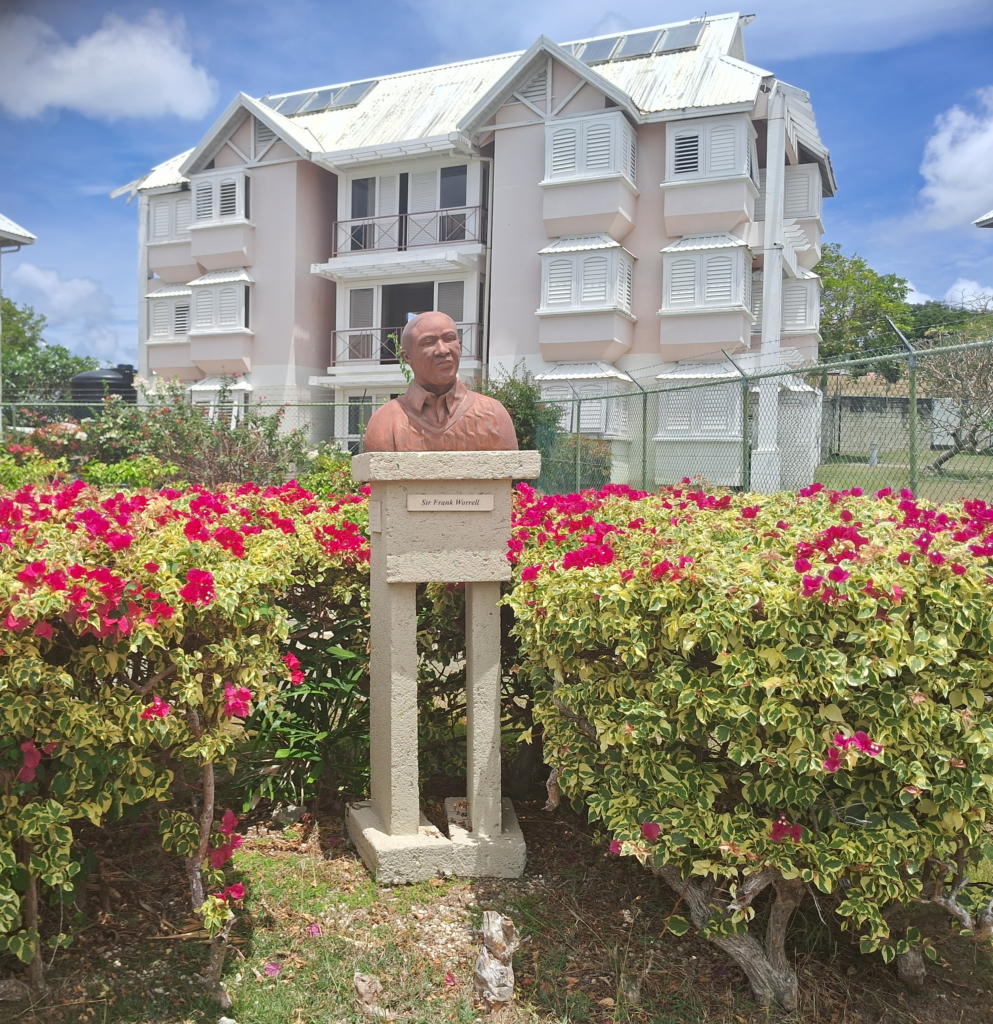
(Above) A bust of Sir Frank Worrell at the Cave Hill Campus of the University of the West Indies (Barbados).
(Left) The tomb of Sir Frank Worrell at the Cave Hill Campus. In the background are three giant pillars designed as cricket stumps.
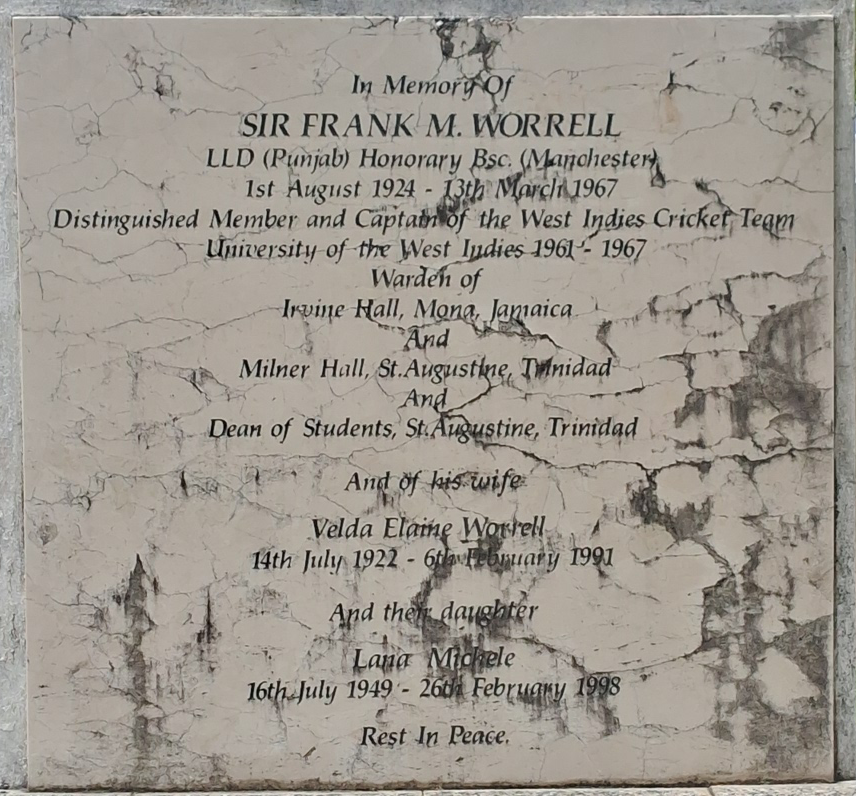
Close up view of the tombstone of Sir Frank Worrell.